
Why the Most Important Skills in Business May Be the Ones AI Cannot Replace


AI can write the email.
It can summarize the meeting.
It can analyze the data, create the presentation, develop the marketing plan, generate
content, organize ideas, and accomplish in minutes what once took us hours.
And this is only the beginning.
For women in business, the possibilities are extraordinary.
But as artificial intelligence becomes increasingly capable, I believe it raises an
important question:
What becomes more valuable when technology can do more of what we once did
ourselves?
Perhaps the answer is not another technical skill.
Perhaps some of the most important skills in business will be the deeply human
abilities AI cannot replace:
Discernment. Trust. Empathy. Judgment. Accountability. Authenticity. Human
connection.
And underneath many of those abilities is something I have spent years studying and
teaching:
Self-awareness.
Not because self-awareness allows us to compete with artificial intelligence.
But because it helps us remain intentionally human while using it.
AI Can Help Us Communicate. It Cannot Build the Relationship for Us.
Imagine you need to have a difficult conversation with an employee, client, business
partner, or even someone you love.
AI can help you prepare.
You can describe the situation and ask:
“How should I approach this conversation?”
Within seconds, you may receive an articulate response with suggested language,
thoughtful questions, and even several ways to phrase your concerns.
Useful?
Absolutely.
But then you must walk into the room.
You must notice the hesitation in the other person's voice.
You must recognize when your words are creating defensiveness.
You must decide whether to keep explaining—or stop and listen.
You must manage your own frustration if the conversation doesn't go as planned.
And you must care enough about the relationship to stay present when the
conversation becomes uncomfortable.
AI can help you prepare for a conversation.
It cannot have the human relationship for you.
That distinction is going to matter more and more.
Polished Communication Is Not the Same as Trusted Communication
We are entering an era in which almost anyone can produce polished communication.
A beautifully written email no longer necessarily tells us much about the
communication skills of the person who sent it.
A professional article does not necessarily tell us whether the author can
communicate well face-to-face.
A sophisticated leadership message does not guarantee that employees trust the leader delivering it.
Technology can improve the quality of our words.
But trust is built through what happens after the words are spoken.
Do we follow through?
Do our actions match what we say?
Do we listen when someone disagrees?
Do we acknowledge mistakes?
Do people experience consistency between who we say we are and how we behave?
AI can help us sound trustworthy.

Only our behavior can make us trustworthy.
That is an important distinction for every leader, business owner, and professional to
remember.
The Danger Isn't Using AI. It's Outsourcing Too Much of Ourselves.
I use AI.
I appreciate what it can do, and I believe it can be an extraordinary tool when used
thoughtfully.
The question is not whether we should use technology.
The better question is:
What should we never outsource to it?
We can outsource a first draft.
But should we outsource our voice?
We can ask AI to help us think through a decision.
But should we outsource our judgment?
We can ask it how to respond to conflict.
But should we outsource the courage required to have the conversation?
We can ask it to write an apology.
But we cannot outsource the humility required to mean it.
We can ask it to generate a message of appreciation.
But technology cannot make us genuinely grateful.
And we can ask it to help us communicate with someone we love.
But it cannot love that person for us.
That is where self-awareness becomes especially important.
We need to know when technology is supporting our humanity—and when it may be
replacing something we need to practice ourselves.
Efficiency Is Valuable. But Not Everything Should Be Optimized.
Business teaches us to value efficiency.
Do it faster.
Automate it.
Streamline it.
Scale it.
And in many areas, that makes perfect sense.
But human relationships do not always become better when they become more
efficient.
Sometimes the most valuable thing we can give another person is ten uninterrupted
minutes of our attention.
Sometimes the best response isn't the fastest response.
Sometimes we need to sit with a difficult question before answering it.
Sometimes an employee doesn't need another system. She needs to know her leader
sees her.
Sometimes a client doesn't need another automated message. He needs to feel heard.
Sometimes the person we love doesn't need us to solve the problem. They need us to
listen.
Technology can save us enormous amounts of time.
Self-awareness helps us decide what deserves the time we save.
The More Powerful Our Tools Become, the More Important Discernment Becomes
There was a time when access to information created an advantage.
Today, information is everywhere.
AI can synthesize enormous amounts of it almost instantly.
So, our challenge is changing.
Increasingly, the question is not:
Can I get an answer?
It is:
What should I do with the answer?
Does this information fit the situation?
What context might be missing?
What are the consequences of acting on it?
Whose perspective haven't I considered?
Does this decision align with my values?
What might I be assuming?
And perhaps one of the most important questions:
Am I using technology to help me think—or to avoid thinking?
That is discernment.
And discernment requires more than information.
It requires knowing ourselves well enough to recognize our biases, motivations,
emotional reactions, values, and limitations.
Human Judgment Requires Something Data Cannot Fully Capture
Data can tell us a great deal.
But people are not spreadsheets.
A business decision that makes perfect sense financially may have unintended
consequences for the people involved.
A team member whose performance has declined may not suddenly be unmotivated.
A client who seems difficult may feel unheard.
A colleague who resists change may see a risk everyone else has overlooked.
A business owner who keeps pushing harder may not need another productivity
strategy. She may need permission to ask herself why stopping feels so
uncomfortable.
Human behavior has context.
And good judgment requires us to remain curious enough to look for it.
This is one reason I believe the ability to understand people will become increasingly
valuable in an AI-driven world.
Not merely knowing what people do.
But being curious about why.
Your Humanity May Become Part of Your Competitive Advantage
As AI makes certain capabilities increasingly accessible, something interesting may
happen.
Being polished will become easier.
Being productive will become easier.
Producing content will become easier.
Analyzing information will become easier.
But being someone people trust?
Someone who listens?
Someone who demonstrates sound judgment?
Someone who can navigate disagreement without destroying a relationship?
Someone who can admit, “I may have gotten that wrong”?
Someone who makes another person feel seen rather than processed?
Those qualities cannot simply be generated on command.
They are developed.
And they are experienced through our behavior.
That matters in leadership.
It matters in business.
It matters with clients.
It matters on teams.
And it certainly matters in our closest relationships.
Before You Ask AI, Ask Yourself
Here is one practice I have begun to think is increasingly important.
Before immediately turning to technology for an answer, occasionally stop and ask
yourself:
What do I think?
What am I noticing?
What am I feeling?
What assumptions am I making?
What matters most here?
What would a thoughtful response look like?
Then use AI.
Compare.
Question.
Explore.
Refine.
Let technology expand your thinking rather than replace it.
Because if we continually outsource the process of thinking, reflecting, writing,
deciding, and communicating, we may become extraordinarily efficient while
gradually weakening some of the very capabilities that make us effective human
beings.
The Human Advantage
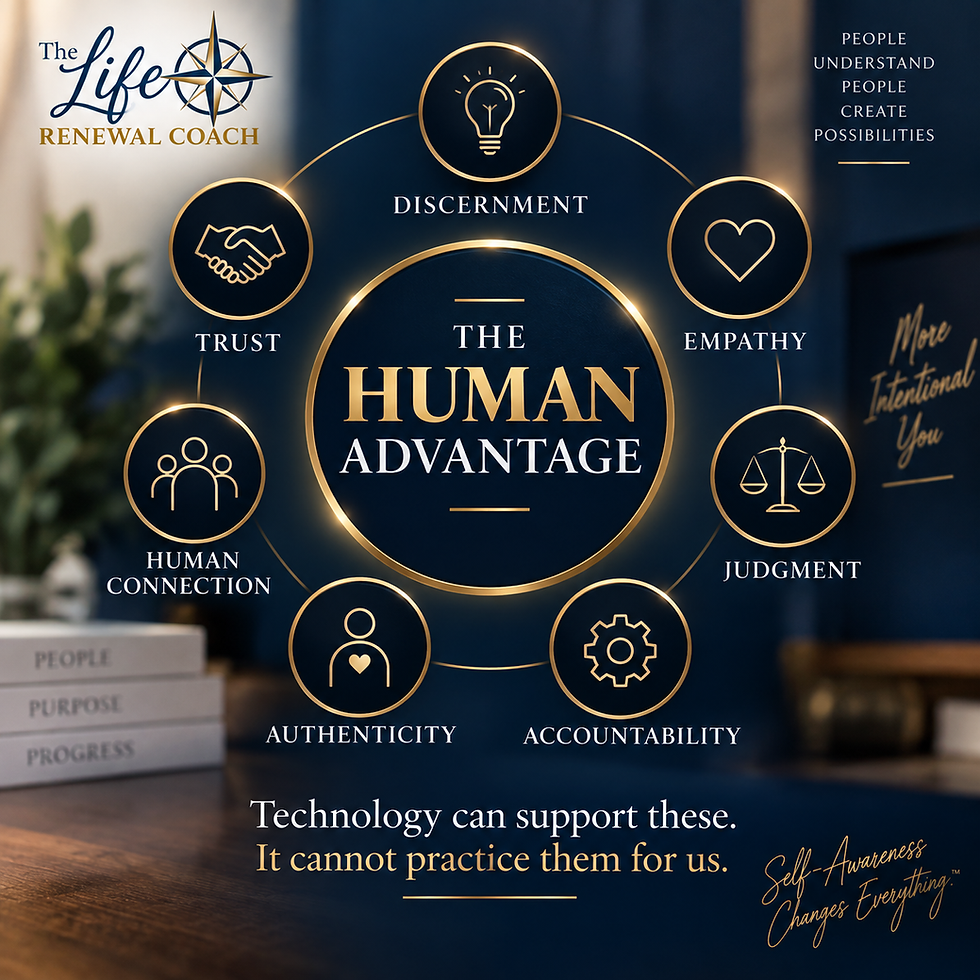
I don't believe our future requires choosing between technology and humanity.
I believe the opportunity is learning how to use one without surrendering the other.
Let AI make us faster where speed matters.
Let it make us more efficient where efficiency helps.
Let it organize information, automate repetitive tasks, and expand what is possible.
But let us continue developing the abilities no technology can practice on our behalf:
To listen.
To discern.
To take responsibility.
To build trust.
To demonstrate empathy.
To have difficult conversations.
To exercise judgment.
To repair relationships.
To act with integrity.
To understand ourselves.
And to genuinely seek to understand one another.
The future may belong not simply to the people who know how to use the most
powerful technology.
It may belong to those who know when to use it, when to question it, and when to
put it aside and simply be human.
And that requires something no algorithm can develop for us:
Self-awareness.
Because technology will continue to change.
But our need to understand ourselves—and one another—will remain profoundly
human.
Self-Awareness Changes Everything. ™
READY TO UNDERSTAND YOURSELF—AND OTHERS—BETTER?
As technology becomes more sophisticated, understanding human behavior becomes
even more valuable.
That is why I created the FREE Self-Awareness Quick Start Guide™.
Inside, you'll discover simple, practical ways to:
Recognize behavioral patterns you may not have noticed.
Better understand why other people may think and respond differently.
Improve the way you communicate.
Strengthen your personal and professional relationships.
Identify one pattern you may want to approach more intentionally.
Whether you're a leader, business owner, professional, part of a couple, or simply
someone who wants to grow, self-awareness is a powerful place to begin.
GET YOUR FREE SELF-AWARENESS QUICK START GUIDE™

Meet the expert:
Coach Glenis McEwen Moss is a former nuclear engineer, corporate executive, international entrepreneur, Human Behavior Strategist, Self-Awareness Coach, Certified DISC Profile Analyst, and Certified Human Behavior Consultant. After becoming a corporate vice president at age 29, she founded an international analytical instrumentation distributorship at 33 and led it for more than 20 years. Today, Glenis helps leaders, business owners, professionals, couples, and individuals better understand themselves and others so they can communicate more effectively, strengthen relationships, navigate conflict, and make more intentional choices through self-awareness and behavioral insights.
Dive Deeper Into Her Wealth of Knowledge:
Follow:


